
Shelby Projected and Actual Release
A projected date is a calculation based on the sentence information, credit rules, and status known to the agency at that time. The actual date is the custody event that was processed. Those can differ. KOOL may show an expected time to serve, a minimum or good-time expiration, parole eligibility, and maximum expiration. A court order, credit adjustment, violation, detainer, or later corrections decision may change what happens before the projected endpoint.
A person awaiting trial at Shelby County Detention Center usually has no sentence-based release date. Bond may be posted, a charge may be dismissed, or the court may enter a release order. Another case or hold can still delay departure. The court event supplies legal authority, while the detention center’s release/removal transaction supplies the physical date, time, purpose, and any receiving custody. One record should not be stretched to answer both questions.
Find a Shelby Release Date
Begin with the person’s custody type. The Kentucky Offender Online Lookup covers KDOC commitments and supervision, including some state inmates housed in county jails. It does not preserve every short Shelby booking. Use the Shelby court and detention center for a local sentence or a pending case. A disappearance from the current jail list is only a clue because transfer and data changes can remove a name too.
- Confirm whether the person is in the county jail, a Kentucky prison, or another system.
- For KDOC custody, search KOOL by name and match the DOC or PID number, conviction details, and location.
- Open the detail and record every date by its exact label instead of choosing the earliest one.
- Check the dated KDOC Daily Releases report near an actual state release.
- For a Shelby jail case, inspect the judgment and ask the detention center for the existing release calculation or transaction.
- Recheck near the projected date because credits, holds, and later decisions may change it.
When a completed county release must be traced beyond the date, the Shelby County released inmate search combines the jail, court, KOOL, VINE, and records-request routes.
KOOL Release Date Fields
KOOL’s search form uses “Projected Release Date From/To” as a filter. A detail record then separates several calculations. Expected Time To Serve, or TTS, is not the same as the maximum sentence endpoint. The Minimum Expiration of Sentence Date is labeled as the Good Time Release Date. Parole Eligibility Date marks when consideration may become possible. Maximum Expiration of Sentence Date is the calculated outer sentence endpoint shown by KDOC.
Eligibility is not a grant. A past parole eligibility date does not prove that a hearing occurred, that parole was approved, that any conditions were met, or that physical release followed. Likewise, a future minimum date can move when credits or sentence data change. KOOL warns that offender information newer than 120 days may not be finalized. Save the access date and pair a recent status with the Daily Releases report or direct agency confirmation.
| KOOL label | What it means | What it does not prove |
|---|---|---|
| Projected Release Date | Search-range estimate | A fixed departure time |
| Expected Time To Serve | KDOC sentence calculation field | Final discharge |
| Minimum Expiration / Good Time | Credit-sensitive minimum calculation | That all credits will remain |
| Parole Eligibility | Possible consideration point | Parole grant or release |
| Maximum Expiration | Calculated sentence endpoint | That no other custody follows |
Note: Report the displayed label and date together, since “release date” alone can blur four legally different Kentucky calculations.
Kentucky Credits for Shelby Releases
KRS 197.045 authorizes sentence credits for qualifying Kentucky prisoners. The statute includes credit for prior confinement under KRS 532.120, specified educational or vocational achievements, approved treatment or life-skills programs, discretionary good behavior of up to ten days per month, and exceptionally meritorious service of up to seven days per month. Some qualifying achievements or programs carry up to 90 days. Credits can also be forfeited, and future credit can be denied after institutional violations under the governing rules.
Consecutive sentences are aggregated for computation. This matters when a single date does not line up with a simple subtraction from one sentence. It is unsafe to calculate a personal release date from the sentence length alone. Corrections must account for the judgment, custody credit, offense dates, aggregated terms, earned credit, forfeiture, and any statutory limit. The public KOOL value is the agency’s current calculation, not an invitation to recreate the arithmetic.
The official county-housed state-inmate credit regulation explains why a Shelby jail location does not always mean a local-only sentence calculation.
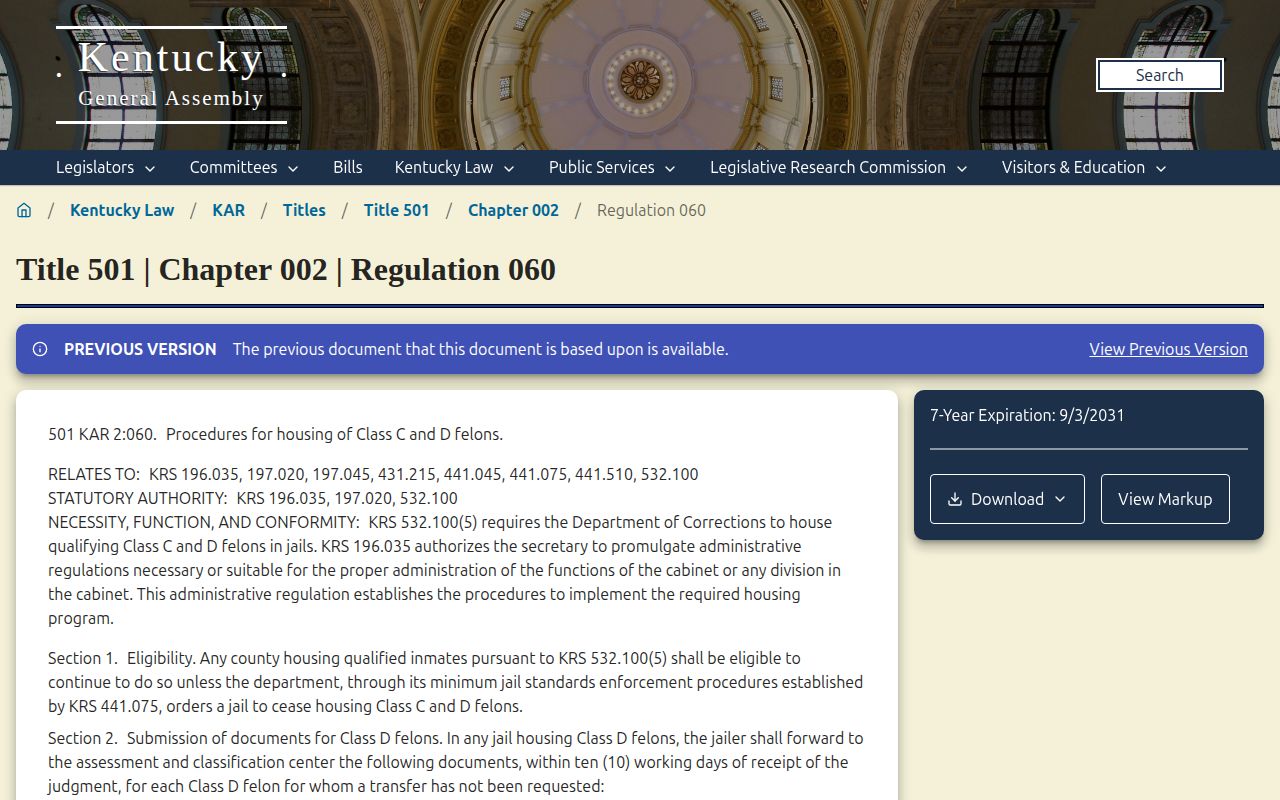
Qualified KDOC inmates housed in a county jail can receive statutory, meritorious, educational, and approved program credits under 501 KAR 2:060.
Shelby Violent-Offender Date Rules
Kentucky’s widely discussed 85 percent rule is not universal. KRS 439.3401 defines the violent-offender class and sets current service limits. For a covered term-of-years violent offender, release through listed early-release routes generally cannot occur until at least 85 percent has been served. Capital, life, and Class A cases have separate provisions, including a 20-year minimum context.
The offense date matters because the statute preserves earlier law for earlier offenses. The conviction, sentence, and statutory classification must be checked before applying any percentage. A charge label alone is not enough. For some nonviolent Class D felony sentences, KRS 439.340 provides an earlier Board review point, but review is not release. Treatment rules, prior history, and other statutory limits can also affect the path.
- Good time
- Credit that can reduce a minimum calculation under the governing rules.
- Parole eligibility
- The point when the Board may consider release, not a promise of release.
- Detainer
- A request or hold that may lead to another agency’s custody.
- Maximum expiration
- The current calculated sentence endpoint shown by corrections.
Why Shelby Release Dates Change
A projection changes when one of its inputs or legal controls changes. Some changes can move a minimum date earlier, while forfeiture or a new hold can move physical departure later. A parole grant may create a route to release, yet release still waits for conditions and processing. Mandatory reentry can add a supervised-release route for a qualifying prisoner. An amended judgment can change the sentence itself.
| Factor | Possible effect | Best confirmation |
|---|---|---|
| Corrected jail credit | Revises time already served | Judgment and KDOC calculation |
| Program or monthly credit | May reduce a minimum date | Current KOOL detail or KDOC record |
| Discipline or forfeiture | May remove or delay credit | KDOC calculation record |
| Concurrent or consecutive terms | Changes sentence aggregation | Judgment and KOOL |
| Parole decision | May allow or defer release | Board sources and KOOL |
| Detainer or other hold | May cause transfer instead of community release | Release/removal transaction |
| Amended court order | Changes sentence authority | Court docket and order |
Data finalization can also revise a recent record without a new legal event. Keep a dated copy of the field used and check again near the expected day.
Shelby County-Jail Date Limits
A short local sentence may never appear in KOOL. Start with the Shelby judgment, including custody credit and whether the term is local or KDOC-controlled. Then ask the detention center for the existing release calculation and completed release/removal record. The county record can distinguish community release from transfer by stating the purpose, authority, time, and receiving custody.
No Shelby-specific local good-time policy, Sunday-release rule, or holiday early-release rule was verified. Those details must not be guessed. The detention center’s administrative hours are not a promise of release-processing hours. For someone still awaiting trial, use the court case to understand the bond or order and the current jail source to learn whether physical custody continues.
Note: A posted bond or dismissal may precede jail processing, and another case or hold can still keep the person in custody.
Confirm Shelby Release Events
KDOC’s Daily Releases PDFs provide the strongest dated public check for a state-controlled release. They list DOC number, name, release type, releasing facility, and highest felony class. The archive has included a person released from Shelby County Detention Center, proving that a state prisoner can leave from the local jail. It remains a KDOC report and does not include all local bond, dismissal, time-served, or transfer events.
For a future custody change, Kentucky VINE may send an alert from a participating source. The VINE Inmate Check explains how to match a record and register. An alert is evidence of what the source agency reported, but it may not explain the court order or destination. Confirm the final event with the jail, KDOC, or court that owns the record.