
Shelby Parole and Probation
Parole and probation both allow a person to live in the community under rules, but they do not come from the same authority. The Kentucky Parole Board decides parole. Parole is a Board-authorized release before sentence expiration, not a pardon or a shorter sentence. A Kentucky court orders probation. Probation may follow a brief stay in the Shelby County Detention Center, replace incarceration, or begin under the terms of a judgment. The KDOC Division of Probation and Parole supervises both statuses after release.
A county jailer does not decide parole and does not supervise probation. The Shelby Circuit Clerk can show the court order behind probation, while the state corrections record shows the active supervision banner and assigned office. These separate records matter when a former detainee is absent from the jail roster. Absence confirms neither parole nor probation. It may instead reflect bond, dismissal, time served, transfer, or another custody change.
| Point | Parole | Probation |
|---|---|---|
| Decision maker | Kentucky Parole Board | Kentucky court |
| When it begins | After Board-authorized prison release | As ordered in the judgment |
| Public verification | KOOL status, parole information, and Board sources | KOOL status and the court case |
| Local supervision | KDOC office shown in KOOL | KDOC office shown in KOOL |
| End point | Final discharge, not physical release alone | Completion or discharge under the court and KDOC record |
Note: Mandatory reentry supervision is a separate statutory route even though current Kentucky law treats the qualifying release as parole.
Verify Shelby Post-Release Status
The official starting point is the Kentucky Offender Online Lookup, known as KOOL. Search with the least data needed, then confirm identity through the PID or DOC number, aliases, conviction details, and location. Open the detail record. Do not rely on a search-result name alone. The banner may state parole, probation, mandatory reentry, postincarceration supervision, or another exact term. Record that term without changing it.
Community status should be checked against the supervision begin and end dates and the office field. An “Active Inmate” banner represents state physical custody, not post-release supervision. A community-supervision banner supports release from the relevant incarceration into the displayed status, but it does not establish final discharge. KOOL also warns that data newer than 120 days may not be finalized, so a recent change deserves confirmation with the office or the court.
- Search KOOL by name, then match the person by DOC or PID number and conviction details.
- Open the full record and copy the exact status banner, supervision dates, and office.
- Check the Shelby court case when probation, a warrant, or a later court order may control.
- If KOOL assigns the Shelbyville office, contact District 12 for the public information it can confirm.
- For parole, separate eligibility, hearing, decision, physical release, supervision, and final discharge.
- Keep the date checked because a later violation, discharge, or data correction can change the record.
The broader Shelby County released inmate search explains how the jail release record and court case fit beside KOOL when custody status is still unclear.
Shelbyville Supervision Office Details
Shelby County belongs to KDOC Probation and Parole District 12. The district covers Shelby plus Anderson, Carroll, Franklin, Gallatin, Grant, Henry, Oldham, Owen, Spencer, and Trimble counties. Its official page lists a Shelbyville satellite office. That office is the local verification route when KOOL assigns the “Shelbyville Office - Shelby County” field. It is not proof that every former Shelby County jail detainee is supervised there.
District 12 Probation and Parole
859 Taylorsville Road
Shelbyville, KY 40065
Phone: (502) 633-3327
Fax: (502) 647-1722
The office assignment follows the supervision record, not the place of physical release. Someone released from Kentucky Correctional Institution for Women may be assigned elsewhere. Likewise, a person released from Shelby County Detention Center may have no KDOC supervision at all. Staff may restrict details that are not publicly releasable. Calling the office is a route to accurate public confirmation, not a promise that the full case file will be disclosed.
Shelby Parole Hearing Stages
The Kentucky Parole Board schedule hub publishes monthly schedules for weekly eligibility hearings and says the schedule page is updated Monday morning. Hearings begin at 8:30 a.m. Eastern. Entries identify the date, time, and location, while eligibility lists identify the offender, DOC number, location, and eligibility month. A hearing may occur before the eligibility date. None of these entries proves that release occurred.
The sequence is eligibility calculation, hearing or file review, decision, physical release, community supervision, and final discharge. A denial, deferment, serve-out, or contingent grant can keep the person in custody. “Serve-out” means service through sentence completion. A contingent grant still requires its conditions and release processing. No comprehensive official name-searchable Board decisions database was found, so person-level follow-up belongs in KOOL’s parole information area and with the Board or KDOC.
The official parole eligibility procedure shows how Kentucky separates eligibility from release. The captured regulation view below is useful for that distinction.
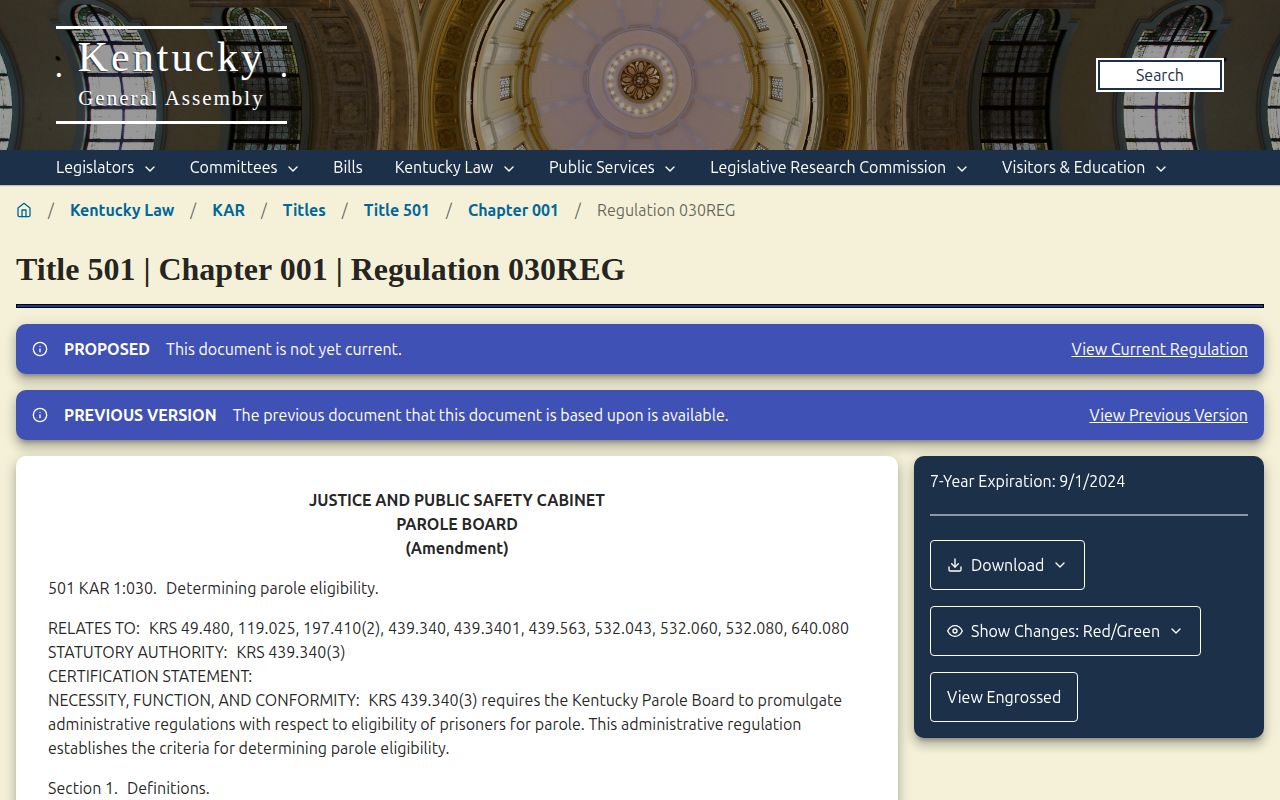
Its rules help explain why a schedule date must never be reported as a guaranteed release date.
Note: Members of the public may follow the schedule hub’s current observation instructions, but observation does not create a right to take part.
Shelby Supervision Warrants and Absconders
An absconder is a person alleged to have stopped reporting or otherwise left compliant supervision status. It is not a new finding of guilt. KOOL has escape and abscond date filters, while the matching Kentucky court case may show a warrant. Shelby County has no confirmed official local absconder list. A status or date in KOOL does not establish that an arrest has occurred, which agency may hold the person, or the outcome of a violation case.
Conditions vary with the order and status. At a high level, supervision can require contact with an officer, approved residence or travel, treatment, fees, and compliance with the law. A suspected violation can lead to review, a warrant, sanctions, or revocation, but the public record must show which step happened. VINE may report a later custody event from a participating agency, yet it does not decide the supervision case. Use KOOL, the court docket, and the assigned office for separate parts of the record.
- Absconder
- A person alleged to be out of contact or compliance with supervision.
- Revocation
- A formal action that can end community supervision and return a person to custody.
- Mandatory reentry
- A statutory form of supervised release for qualifying prisoners before projected completion.
- Final discharge
- The later completion of parole obligations, distinct from leaving physical custody.
Shelby Reentry Support After Release
KDOC publishes two distinct reentry routes that matter in Shelby County. Its county-jail reentry page identifies Erin Carter at (606) 303-0897 as the coordinator covering the Shelby, Boyle, and Marion county jails. The KCIW reentry page identifies institution contacts reached through KCIW at (502) 241-8454: Nicole Lowry-Hall at extension 2285, Brittany Piascik at extension 2254, and CTO Sarah Heath at extension 2351.
These contacts help with transition and support. They are not release-record custodians and do not replace KOOL or District 12 for supervision verification. The split also prevents a common Shelby error. A person leaving the county detention center follows the county-jail path, while a person leaving KCIW follows a state-prison path. KCIW houses women from all Kentucky counties, so physical release in Shelby does not establish a Shelby case or Shelby supervision office.
Property After Shelby County Release
Release logistics can overlap with supervision, especially when a person needs records or property for the first office contact. Kentucky jail regulation requires the return of admission property that is not lawfully confiscated or retained, along with a signed receipt. A specific written complaint about returned property must be made within 24 hours of release. This state rule concerns jail property handling. It does not establish a release hour, exit door, or transit plan for Shelby County.
The official Shelby jailer page adds one narrow local rule. A commissary package arriving after release or transfer is held for seven days for pickup by the former inmate or family. That statement should not be expanded into a policy for all personal property. When an item is missing, keep the signed receipt and address the specific property issue fast. Supervision questions still go to the office shown in KOOL.
Note: Shelby publishes no verified general release schedule or family waiting rule, so arrangements should be confirmed directly with the detention center.
When Shelby Supervision Ends
Physical release and final discharge are separate events. A parolee may live in the community while the sentence and supervision continue. KRS 439.354 addresses final parole discharge, and KRS 439.356 describes its legal effect on later detention for that completed parole. For probation, the court record and KDOC status should show completion, discharge, extension, or a later violation. An expected end date alone is not the same as a posted final action.
Check the current KOOL banner and dates, then obtain the relevant court or agency record if the end of supervision must be documented. Preserve the exact status and the date accessed. A removed jail entry proves little about discharge, and a past parole eligibility date proves even less. Reliable verification names the type of supervision, assigned office, start and end dates, and any final discharge shown by the authority that created the record.