
KCIW Release and Transfer Paths
A woman leaving KCIW may enter the community after sentence completion, parole, or mandatory reentry supervision. She may also transfer to another Kentucky prison, leave for court transport, or enter another agency’s custody. Each event ends physical placement at KCIW, but only some are community releases. A new location in the state record should never be recast as discharge without a matching status or release entry.
KCIW releases belong to the Kentucky Department of Corrections. The main public trail combines Kentucky Online Offender Lookup, known as KOOL, with the KDOC Daily Releases archive. KOOL shows current state custody or supervision and sentence-related fields. The dated PDFs can show the DOC number, name, type of release, releasing institution, and highest felony class. Kentucky VINE may add a custody-event alert, while Parole Board and supervision sources explain later stages.
| KCIW record | Meaning | What it does not prove |
|---|---|---|
| Active Inmate | Current physical KDOC custody | A future release date is guaranteed |
| Community-supervision banner | Prison custody ended for that displayed status | The sentence and supervision have ended |
| Daily Releases entry | Dated KDOC release type and institution | Every later legal status |
| New prison location | Transfer within the system | Release to the community |
Confirm a KCIW Release
Begin with the least amount of identifying data needed in KOOL. Search a name, alias, DOC or PID number, then compare the conviction and identity fields before opening a match. Results can include the name, current location, identifiers, offense counts, and photo availability. The detail record matters most because it carries the exact status banner and the institution or supervision fields.
- Search KOOL by name or DOC/PID number and confirm the person through more than a common name.
- Open the detail and record the precise status, location, identifiers, and access date.
- Check supervision begin and end dates plus the named office if a community status appears.
- Search the KDOC Daily Releases PDFs around the suspected date and match the DOC number, person, releasing institution, and exact release type.
- Use Kentucky VINE for a participating custody event, then request the KDOC release record if a durable or corrected record is needed.
KOOL warns that information newer than 120 days may not be finalized. For a recent KCIW departure, save what the system displays and compare it with the dated release report. A “Released” event in VINE reflects what a participating source sent, but it may not state the destination or explain the court and sentence history. The Shelby County released inmates search explains how the state-prison path differs from the local jail path.
KCIW Release Records Contact
The official KCIW page gives the public location used here. Some other KDOC materials use a different Ash Avenue number or a post office box, so addresses from separate sources should not be silently merged. The main telephone can route a facility-specific inquiry, but underlying release and discharge records are held through the state corrections process.
2401 Ash Avenue
Pewee Valley, KY 40056
Phone: (502) 241-8454
Operator: Kentucky Department of Corrections
For an agency record, send a written request to KDOC Open Records at correctionsopenrecords@ky.gov or Department of Corrections, Open Records Request, P.O. Box 2400, Frankfort, KY 40602-2400. Identify the person and DOC/PID number, if known. Ask for the final release or discharge record, actual release date, release type or status, releasing institution, and releasable offender photograph. Describe existing records instead of asking the agency to create a narrative.
The public KOOL entry should be checked first because it may resolve the narrow question. A written request is useful when the displayed data is unclear, changes, or conflicts with a dated report. Kentucky’s Open Records Act, KRS 61.870 through 61.884, governs access subject to lawful exemptions, redaction, and agency possession. Ask for electronic copies and an estimate before costs are incurred.
KCIW Release Date Fields
KOOL’s search form includes a Projected Release Date From/To filter, but a detail page separates several calculations. Expected Time To Serve is labeled TTS. Minimum Expiration of Sentence Date is also labeled the Good Time Release Date. Parole Eligibility Date marks when consideration may occur. Maximum Expiration of Sentence Date is a calculated sentence endpoint. None should be turned into a promised departure date.
| KOOL field | How to read it |
|---|---|
| Projected Release Date filter | A search range, not one guaranteed exit appointment |
| Minimum / Good Time date | A credit-dependent sentence calculation |
| Parole Eligibility Date | Potential consideration, not a grant or release |
| Maximum Expiration Date | A calculated endpoint that remains distinct from actual discharge |
Calculations can change after earned-credit decisions, forfeiture, corrected jail credit, amended judgments, sentence aggregation, parole action, a detainer, or data finalization. A past eligibility date does not mean the Parole Board granted release. If KOOL still says Active Inmate, the public state record shows continued custody. If it shows parole, probation, mandatory reentry, or postincarceration supervision, quote that exact label instead of calling every status parole.
KCIW Releases Across Kentucky
KCIW opened in 1938 and occupies a 270-acre campus near Pewee Valley. It serves adult female felons from all 120 Kentucky counties and spans custody levels. These facts make its Shelby County location important but easy to misread. A woman may be physically released in Shelby County even though her prosecution, home county, supervision office, and later court records are elsewhere.
The official facility image and history appear on the KCIW information page.
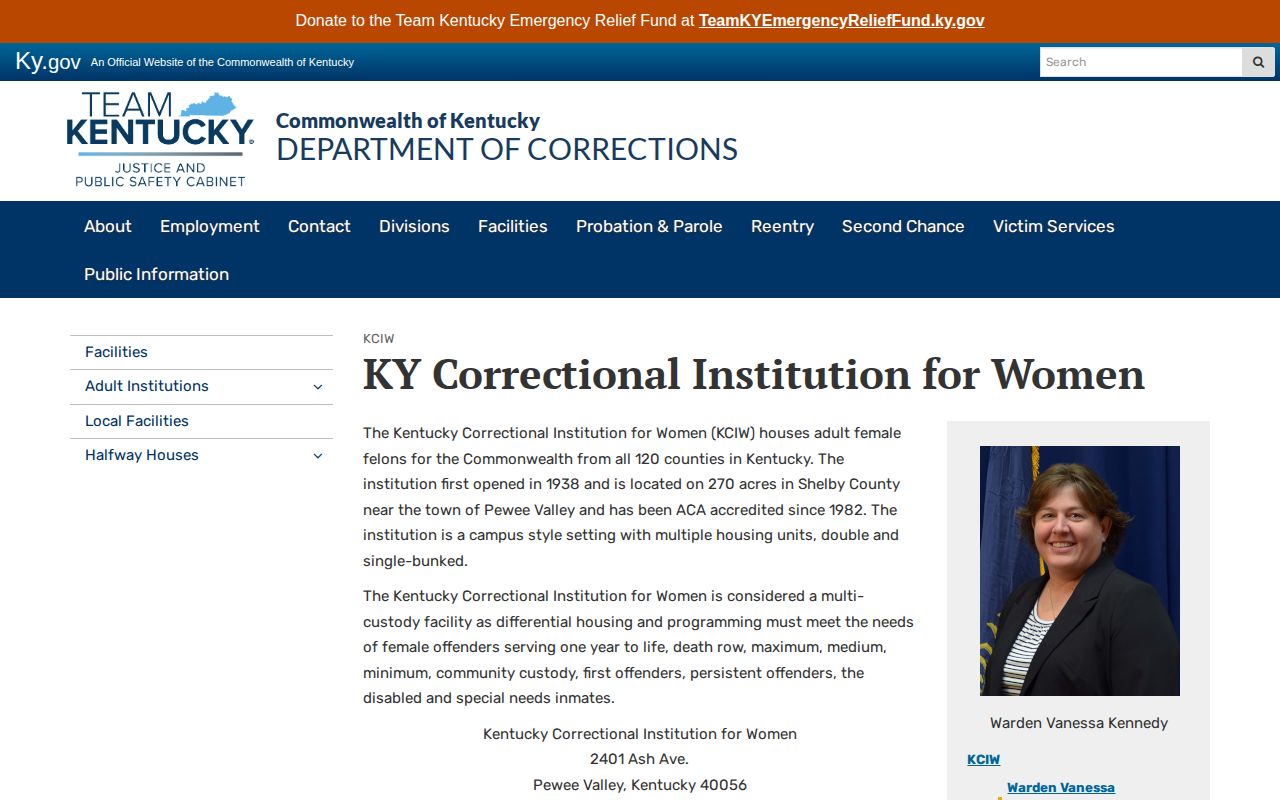
The institution page confirms why a KCIW record belongs in the statewide KDOC path rather than the Shelby County jail list. Search the conviction county and assigned supervision office as separate fields. A Shelby location does not make the person a Shelby defendant or resident.
KCIW Post-Release Supervision
A community-supervision banner supports departure from prison custody into the status shown, subject to the record’s freshness warning. It does not establish final discharge. Parole is Board-authorized release before sentence expiration. Mandatory reentry supervision is a statutory route for qualifying prisoners. Postincarceration supervision may follow the custodial sentence by law. Probation is imposed by a court. These terms should not be blended.
- Parole
- Conditional community release authorized by the Kentucky Parole Board before sentence expiration.
- Mandatory reentry
- A statutory form of supervised release for a qualifying prisoner under stated rules.
- Final discharge
- Later completion of parole obligations, distinct from leaving KCIW.
- Serve-out
- A direction or result that keeps the person serving the sentence to completion.
When KOOL names the Shelbyville Office, KDOC Probation and Parole District 12 is the local route for appropriate public verification. Another office means the supervision county differs from the prison’s physical county. An office assignment should not be treated as a home address. Full post-custody distinctions and the local office route appear on the Post-Release Supervision page.
KCIW Release Support Contacts
KDOC identifies institution-specific reentry coordinators at KCIW. The research lists Nicole Lowry-Hall at extension 2285, Brittany Piascik at extension 2254, and CTO Sarah Heath at extension 2351 through the facility’s main number. These staff form a genuine institution support path. They are not a substitute for KOOL, a Daily Releases report, or an open-records response when the question is whether release occurred.
KDOC also documents treatment modalities at the prison. Treatment and transition services may matter to release planning, but participation should not be inferred from a person’s presence at KCIW. Contact the institution for the current role, program, and extension before relying on old details. Record verification should remain with the system or office that owns the status field.
Note: Reentry contacts help with transition support, while KOOL and KDOC records supply the official public release trail.
Correct Conflicting KCIW Records
When sources disagree, identify the exact disputed field. Send a KOOL status, date, location, or identifier problem to KDOC. A Parole Board schedule is evidence of a planned hearing, not a release result. A court order can explain authority, while the state release record confirms the custody transaction. Save the access date and exact labels before reporting a change.
If no authoritative resolution is available, keep the claim narrow. A Daily Releases PDF can establish the date, release type, and KCIW as the releasing institution for a matched DOC number. KOOL can establish the current status displayed when checked. Neither should be stretched into a claim about a residence, an unlisted destination, or final discharge.